Small group
From€45Book now

The Jewish Ghetto is a small historic quarter by the Tiber, home to Europe's oldest continuous Jewish community, ancient Roman ruins and a distinct cuisine. Here is its history, sights and food.
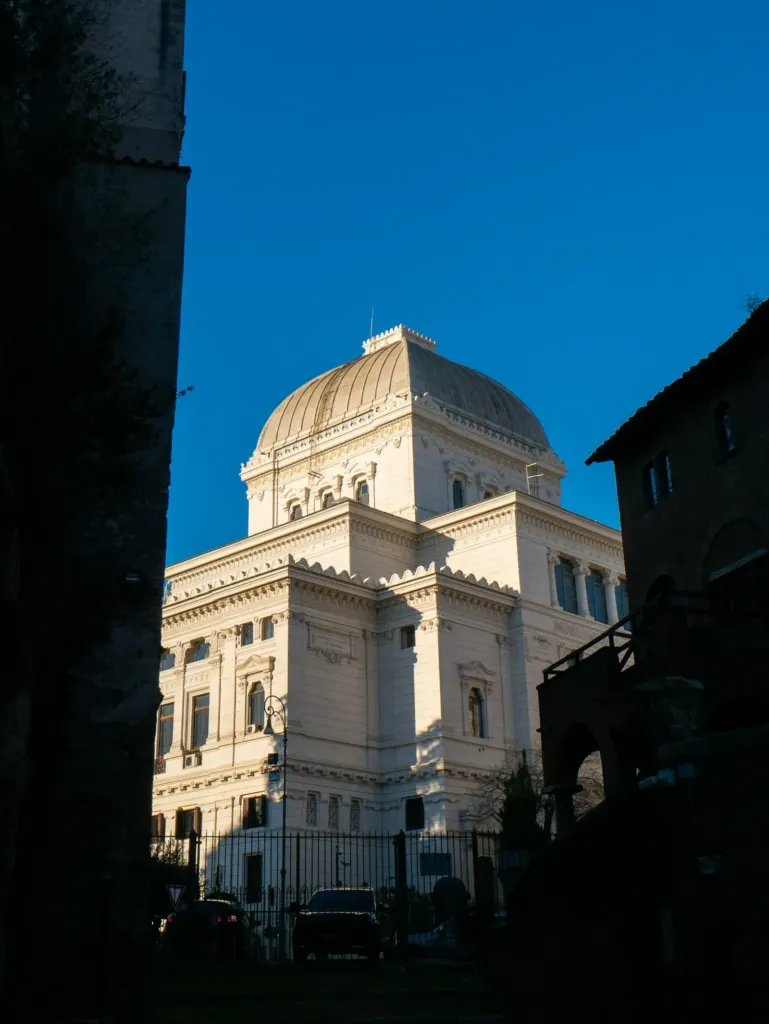
The Jewish Ghetto is a small quarter between the Tiber, the Portico d’Ottavia and Piazza Mattei, where Rome’s Jewish community was confined from 1555 until 1870. Jews have lived in Rome since the second century BC, which makes it one of the oldest continuous Jewish communities in Europe. Today the quarter combines Roman ruins, a synagogue and museum, quiet Renaissance squares and some of the city’s most distinctive food. Yes, it is worth visiting, especially if you like history and cooking.
A walk with a guide adds the stories behind the streets; see the Jewish Ghetto history and food walk or our best food tours in Rome.
It is known for its history, for the synagogue, and for Roman-Jewish cooking. In 1555 Pope Paul IV issued the bull Cum nimis absurdum, which ordered Rome’s Jews to live in a walled area, with gates locked at night. Residents faced restrictions on trades and property, and for a period were required to attend conversion sermons. The walls were removed after Rome joined the Kingdom of Italy in 1870, and the old district was largely demolished and rebuilt in the following decades, which is why its look today is partly late-nineteenth century.
The community’s darkest chapter came on 16 October 1943, when German forces rounded up over a thousand Roman Jews, most of whom were deported to Auschwitz. Memorials in the quarter, including brass “stumbling stones” (pietre d’inciampo) set into pavements, record this history.
Roman-Jewish cuisine grew from kosher rules, local ingredients and the limits of ghetto life. Classic dishes include:
For other Roman classics see a beginner’s guide to eating like a Roman.
Yes, because it concentrates a lot into a few streets: a first-century BC portico, a theatre that predates the Colosseum, a nineteenth-century synagogue and a living food tradition. It is quieter than the nearby Pantheon area, and it rewards slow walking. If you only have an hour, walk the Portico d’Ottavia and Via del Portico d’Ottavia, look at the Turtle Fountain and stop for something fried. With a guide, you also hear how the ghetto’s rules shaped everyday life, which is hard to infer from the buildings alone.
Tram 8 to Arenula is close by, and it is a ten-minute walk from Campo de’ Fiori and Largo di Torre Argentina. From the Pantheon it is also a short walk, and Tiber Island and Trastevere lie just across the river.
Trastevere is across the river; see the Trastevere guide. The Capitoline Hill and Campo de’ Fiori are also nearby. See food lover’s Rome for more.
Its history as the walled district where Rome's Jews were confined from 1555 to 1870, the Great Synagogue and Jewish Museum, ancient ruins such as the Portico d'Ottavia, and Roman-Jewish food.
Carciofi alla giudia (fried artichokes), fried salt cod, fried courgette flowers, marinated courgettes and pizza ebraica, a dense fruit-and-nut cake. Artichokes are best in spring.
Yes, if you like history and food. It is compact, close to major sights, and combines Roman ruins with the story of one of Europe's oldest Jewish communities.
Tram 8 to Arenula, or walk about ten minutes from Campo de' Fiori or Largo di Torre Argentina. It is also a short walk from the Pantheon.
The Portico d'Ottavia, Teatro di Marcello, the Great Synagogue and Jewish Museum, the Turtle Fountain and memorials, plus restaurants and bakeries.
Related tours, guides and places.
Eight of our listed Rome tours start at €50 or less, from a river cruise to the Vatican…
Rome in winter is mild by northern standards, damp at times and far less crowded outside the holiday…
The best walking tour in Rome depends on the theme you want: ancient ruins, food and history, a…
Rome is easier on a budget than most capitals: many of its best sights are free. Spend on…
The best food in Rome is in the neighbourhoods, not on the monument squares. Head for Testaccio, Trastevere,…