Small group
From€85Book now

Tivoli, about 30 km east of Rome, has two UNESCO sites: Villa d'Este with its fountain gardens and Hadrian's Villa, an emperor's country estate. Public transport works but a guided trip is easier for both.
Tivoli is a hill town about 30 km east of Rome with two UNESCO World Heritage sites: Villa d’Este, a 16th-century palace with terraced fountain gardens, and Hadrian’s Villa, the vast country estate of the 2nd-century emperor. You can reach Tivoli from Rome by regional train from Roma Tiburtina or by CoTral bus from Ponte Mammolo in about an hour, but Hadrian’s Villa lies a few kilometres below the town, so seeing both on your own takes planning.
Ancient Tibur was a place Romans escaped to. Cooler than the city and rich in water, it attracted aristocrats and emperors, and the nearby travertine quarries supplied the stone for much of Rome, including the Colosseum. Today it is a small hill town with a medieval centre, a gorge garden (Villa Gregoriana) and a waterfall. Most visitors come for the two villas.
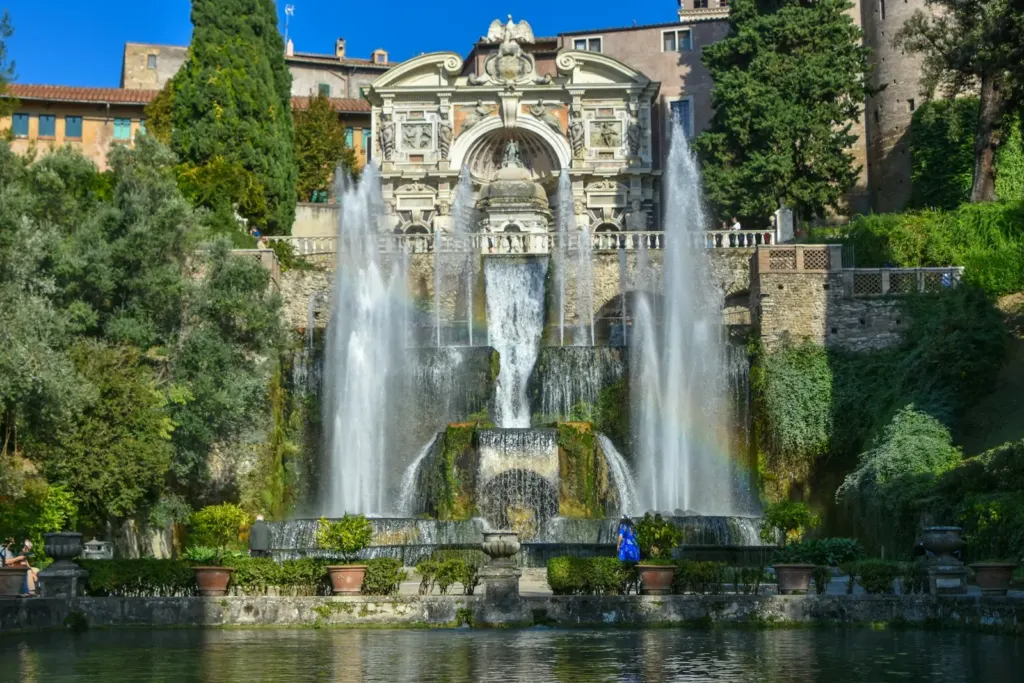
Cardinal Ippolito II d’Este, governor of Tivoli, turned a former convent into a Renaissance villa in the 1550s and had the hillside terraced into gardens. The special feature is water: hundreds of jets, basins and cascades are fed by gravity rather than pumps, using the Aniene river diverted through the hill.
The gardens are steep, with many steps, so expect some effort on the way back up. Go in spring, when the fountains look their best, or on a hot day when the shade is a relief.
Hadrian’s Villa (Villa Adriana) is the sprawling estate built by Emperor Hadrian from about AD 118. It covers well over 100 hectares and was more a small city than a house: baths, theatres, libraries, courtyards and gardens. Look for the Canopus, a long pool lined with columns and statues, the Maritime Theatre, a circular island retreat, and the Great Baths with their vaulted ruins. Many of the original statues are now in museums, so a lot of the pleasure is in the scale and architecture, and some imagination. The site has a site model and visitor centre at the entrance that help to orient you.
They are very different. Choose Villa d’Este if you like gardens, fountains and photography; choose Hadrian’s Villa if you like ancient architecture and open space. If you only have time for one, history fans tend to prefer Hadrian’s Villa, while visitors who find ruins hard to read often enjoy Villa d’Este more. A guided visit helps at Hadrian’s Villa because there is little context to the ruins on their own.
| Option | Details | Typical time |
|---|---|---|
| Regional train | From Roma Tiburtina to Tivoli station, running roughly hourly; the town centre is a walk or short bus ride from the station | About 45 to 60 minutes |
| CoTral bus | From Ponte Mammolo (Metro B) to Tivoli; some services stop near Hadrian’s Villa | About 50 to 70 minutes, depending on traffic |
| Local bus between sites | Local bus from Tivoli to the Hadrian’s Villa area, a few kilometres away | About 10 to 20 minutes |
| Guided day trip | Transport, guide and entry combined | About 7 hours round trip |
Check current details: train and bus timetables and fares change, and strikes occasionally disrupt service. Check Trenitalia and CoTral for the day you travel. Villa d’Este and Hadrian’s Villa each have their own opening hours; Villa d’Este is generally closed on Monday mornings, but the Ministry of Culture lists changing arrangements, so check before you go. Our guide to getting around Rome explains how to reach Tiburtina and Ponte Mammolo.
For garden lovers and history fans, yes. It is closer than Pompeii or Florence, cooler in summer and less crowded than central Rome. On a short trip, however, a Tivoli day eats a large part of your time in Rome, and if you only have two or three days, it is probably not the first thing to add. It is easier if you are in Rome for four or more days or have already seen the main sights. If you want one lower-effort option, Ostia Antica is nearer. See the day trips guide for more options.
Yes, but it is a full day. Plan to do one site in the morning and the other in the afternoon, allow about two hours for each, and add time for lunch and the bus between them. In summer, start with Hadrian’s Villa early, before the heat, and finish with the shaded gardens at Villa d’Este. A guided tour solves most of the logistics: our Tivoli tour of Hadrian’s Villa and Villa d’Este (from EUR 85, about 7 hours, transport, guide and entry included) covers both.
Spring and early summer show the gardens at their best. Midsummer is hot at Hadrian’s Villa, which has little shade. Wear comfortable shoes with good grip, bring water, and expect steep paths at Villa d’Este. Weekdays are quieter than weekends. Look at the month-by-month guide to plan timing.
For options that include transport, see day trips from Rome.
Take a regional train from Roma Tiburtina or a CoTral bus from Ponte Mammolo metro station. Both take roughly an hour. The villas are not in the same place, so you also need a local bus or taxi to reach Hadrian's Villa.
Yes, if you like gardens or ancient history and have time. It is closer and cooler than most day trips, but it takes most of a day, so it suits visitors with at least four days in Rome.
Allow about two hours for Villa d'Este and two to three hours for Hadrian's Villa, plus travel between them and lunch. Together this is a full day, usually seven to nine hours from Rome.
It depends on taste. Villa d'Este is a Renaissance garden of fountains, ideal for photography and hot days. Hadrian's Villa is an ancient imperial estate, better for history lovers. If you must pick one, choose by interest.
Yes, though it is a full day. Start early with Hadrian's Villa, have lunch in Tivoli town and finish at Villa d'Este. A guided tour with transport removes most of the planning.
Villa d'Este is generally closed on Monday mornings, with changing Monday afternoon arrangements. Hours also change by season, so check the official site before travelling.
Related tours, guides and places.
Seven of our tours run six hours or more: five day trips from Rome, a private city day…
Four days gives Rome room to breathe: ancient Rome, the Vatican, the Borghese Gallery with the baroque centre,…
The easiest day trips from Rome are Ostia Antica, Tivoli, Orvieto and Florence, all doable by train. Pompeii…
Three full days covers the big sights comfortably, and four is the sweet spot if you want a…
Rome in summer is hot and bright, but very doable if you sightsee early, rest at midday and…