Private
City walks
Private Rome Highlights Tour with Local Guide
6 hoursModerateFree cancellation
Free cancellation
From€349Book now

The Pantheon is Rome's best-preserved ancient building and Piazza Navona a Baroque square on the site of a Roman stadium. Here is how entry works, what to see and how to link them.
The Pantheon is the best-preserved building of ancient Rome, a temple turned church whose concrete dome and open oculus have drawn visitors for nearly two thousand years. A few minutes away, Piazza Navona is a Baroque square that follows the outline of a Roman stadium. Both sit in the heart of the historic centre and make an easy walk together. Note that the Pantheon is no longer free: it has been ticketed since 2023, so check current entry rules before you go.
No, for most visitors. The Pantheon introduced a ticket in 2023. According to a notice from Italy’s Ministry of Culture, the standard ticket was set at EUR 7 from 1 July 2026, with reduced or free categories (including under 18s, Rome residents and people attending Mass). Details differ between sources on first-Sunday free entry, so treat that as unconfirmed. Tickets are sold on site and through the Musei Italiani portal, and visits are in order of arrival, so there is no real skip-the-line option. The Pantheon remains a working church, so sales may pause around Mass. Check current details on the official page before you go.
Do you need to book? Not usually, but check for queues and for any timed-entry changes.
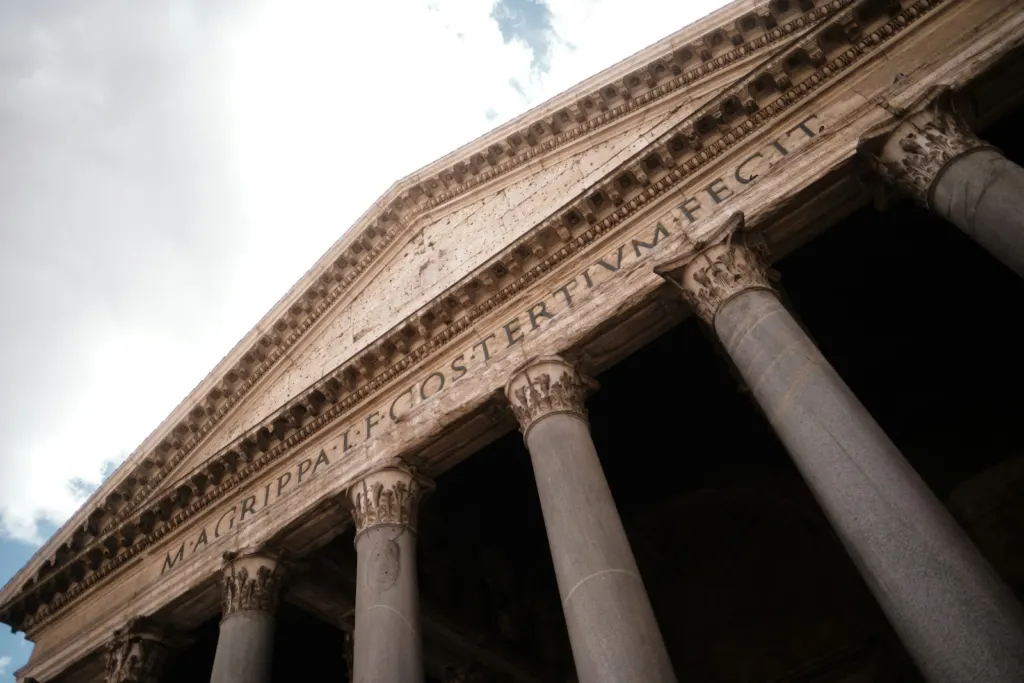
The first Pantheon was built by Marcus Agrippa, Augustus’s right-hand man, around 27-25 BC. After fires, Emperor Hadrian rebuilt it around AD 118-128, keeping Agrippa’s name in the inscription on the portico. Its dome is 43.3 metres across and was long the largest in the world; it is still the largest unreinforced concrete dome ever built. The ceiling is lightened with coffers and the concrete gets lighter in aggregate as it rises. At the top is the oculus, an open circle roughly 8 metres wide that lights the interior.
In AD 609 the building was given to the Church and consecrated as Santa Maria ad Martyres, which helped it survive when other temples were stripped. Raphael is buried here, along with Italy’s first two kings, Vittorio Emanuele II and Umberto I.
Visits typically take 30 to 45 minutes. Dress respectfully, because it is a church, and keep quiet.
The long oval square follows the outline of the Stadium of Domitian, built about AD 86 for athletic contests. Over the centuries houses were built over the stands, leaving the oval shape. In the seventeenth century Pope Innocent X made it a showpiece of Baroque Rome, and it was used for festivals, including flooding the square for summer events, until the nineteenth century.
The square is lively with artists and street performers, and cafes around the edge are better for the view than for the prices.
About an hour for the Pantheon and Piazza Navona together, or two to three hours if you add nearby churches and a coffee stop.
The first opening hour on a weekday morning is usually quietest, and late afternoon before closing is often calmer than midday. The Pantheon is open daily according to the Ministry’s notice, with last entry about half an hour before closing, but hours may change. Piazza Navona is best early in the morning or in the evening, when the fountains are lit.
There is no metro station next to the Pantheon, which is part of its charm. Buses stop at Largo di Torre Argentina, about a five-minute walk away, and Spagna or Barberini metro stations are about 15 to 20 minutes on foot. Piazza Navona is five minutes’ walk from the Pantheon. See getting around Rome.
There is no tour hub dedicated to the Pantheon, so for guided options see best walking tours in Rome and best night tours, or our broader things to do in Rome.
Not for most visitors. A ticket has been required since 2023, and the Ministry of Culture set the standard price at EUR 7 from July 2026. Under-18s and Rome residents are free. Check the official page for current rules.
Usually not, as visits are in order of arrival. You can buy a ticket online through the official portal or on site. There is no real skip-the-line option, so go at quieter times.
Thirty to forty-five minutes inside is enough for most visitors. Allow an hour for the Pantheon and Piazza Navona together, more if you add nearby churches.
Bernini's Fountain of the Four Rivers, Borromini's Sant'Agnese in Agone and its oval shape, which follows the Stadium of Domitian. It is lively with artists and cafes.
Early on weekday mornings, or late afternoon before closing. Midday and weekends are busiest. The Pantheon is a church, so access can pause during Mass.
Related tours, guides and places.
The best tour in Rome depends on what you want from it, but for most first-time visitors a…
The best family tours in Rome are short, active and built for children's attention spans: a treasure hunt,…
Seven of our tours run six hours or more: five day trips from Rome, a private city day…
A Rome tours guide is mostly a decision guide: pick the sights that need advance tickets, choose how…
Rome works well with children if you plan in short bursts. Pair one big sight with a game,…
One day in Rome is enough for a clear first impression. Book a timed Colosseum slot, walk the…